Photos used to be proof.
Courts accepted them. Newspapers printed them. For a century and a half, a photograph was an artifact of a moment that actually happened — an imperfect but followable chain from scene to print.
1860s — Civil War photojournalism.
1975 — First digital sensor, Kodak.
2010s — Raw metadata as provenance.
Then, in eighteen months, every image on the internet became suspect.— The turn, 2023–2024
AI changed that.
A laptop and a diffusion model now fabricate people who never existed, at events that never happened — indistinguishable from a real photograph on every metric that matters.
Watermarks come off. Metadata strips. Detection models lag the generators by months — and the gap is widening.
 Camera · signed
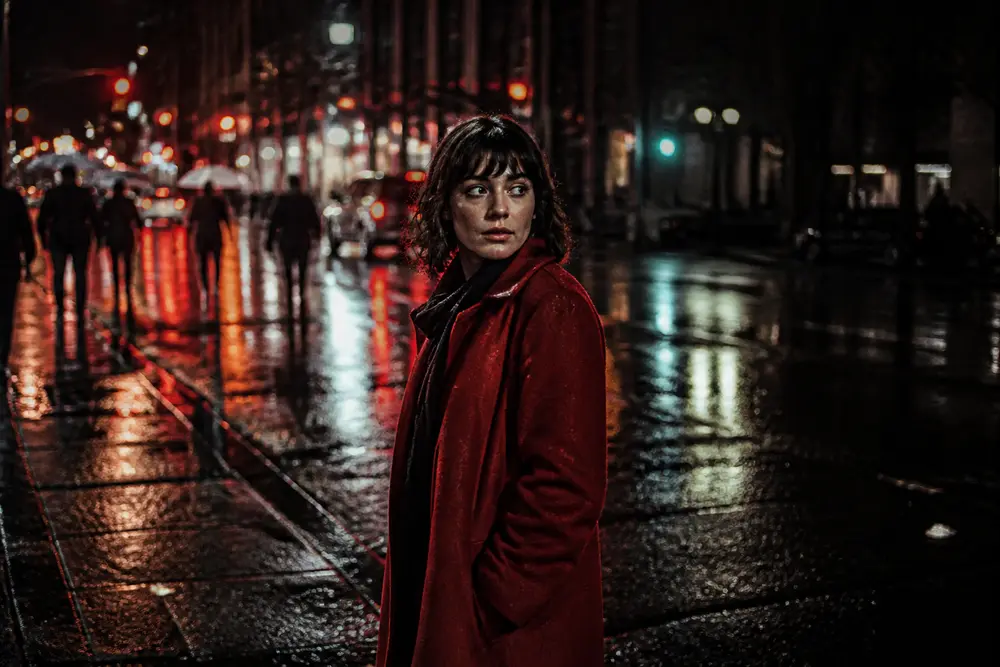 Generated
The systems that depend on images are breaking.
Visual truth is load-bearing across civic life. Each of these domains has lost a reliable test for “this image is of a real scene.”
The cost to fabricate collapsed; the cost to verify didn't. Every domain below assumed an asymmetry that is gone.
Journalism
Fabricated “eyewitness” photos outrun the debunk.
Legal evidence
Chain-of-custody assumed photos were hard to forge.
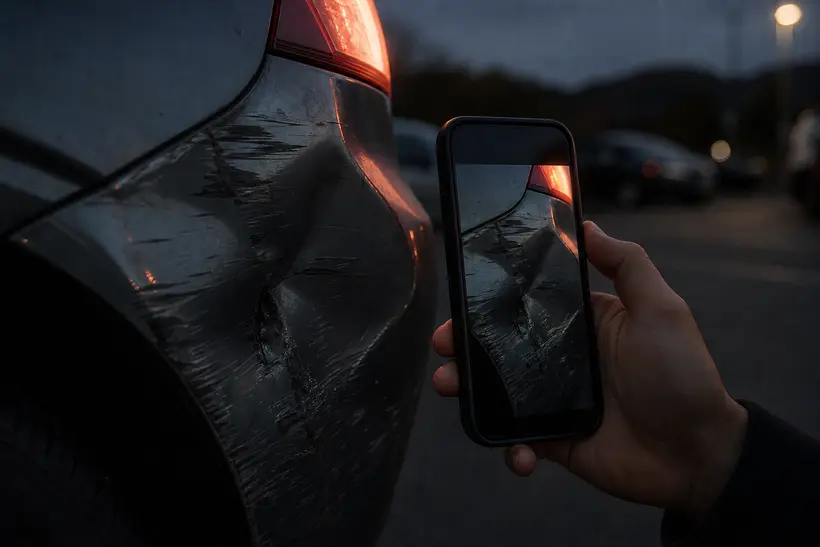
Insurance
Damage photos are now trivially generated.
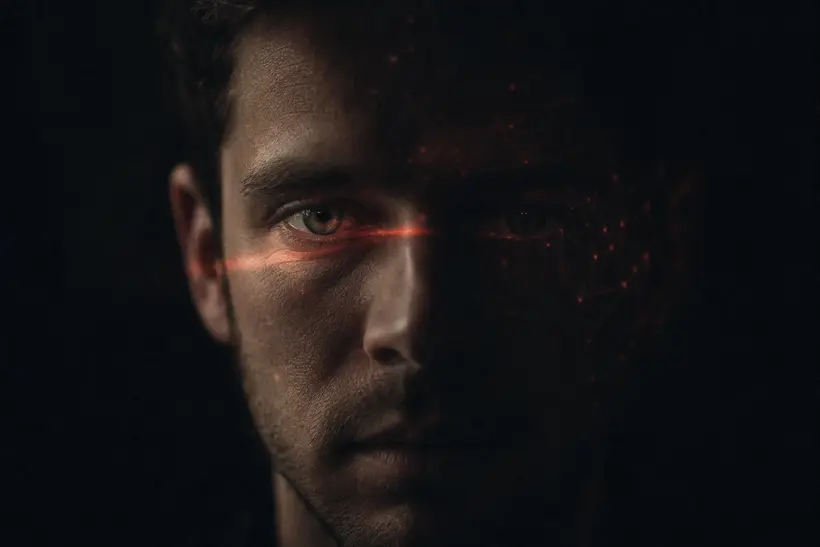
Identity
Synthetic faces clear liveness checks in bulk.
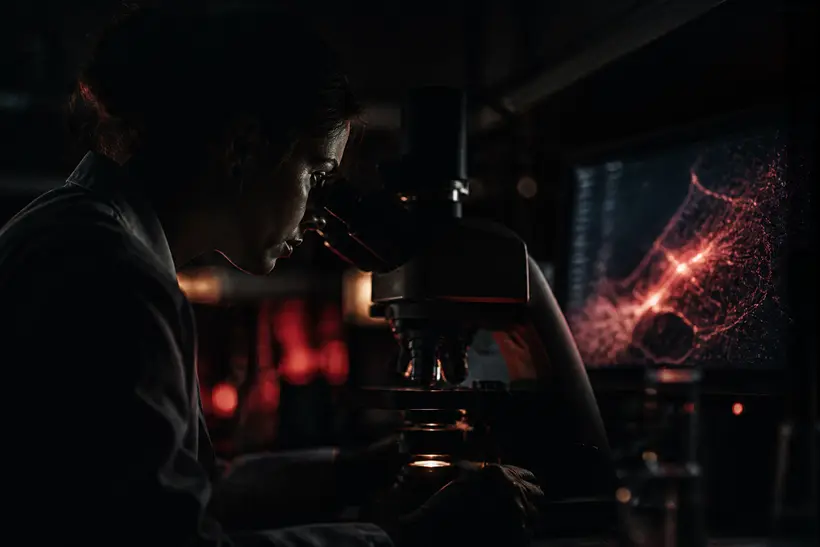
Science
Fabricated figures, climbing retractions.
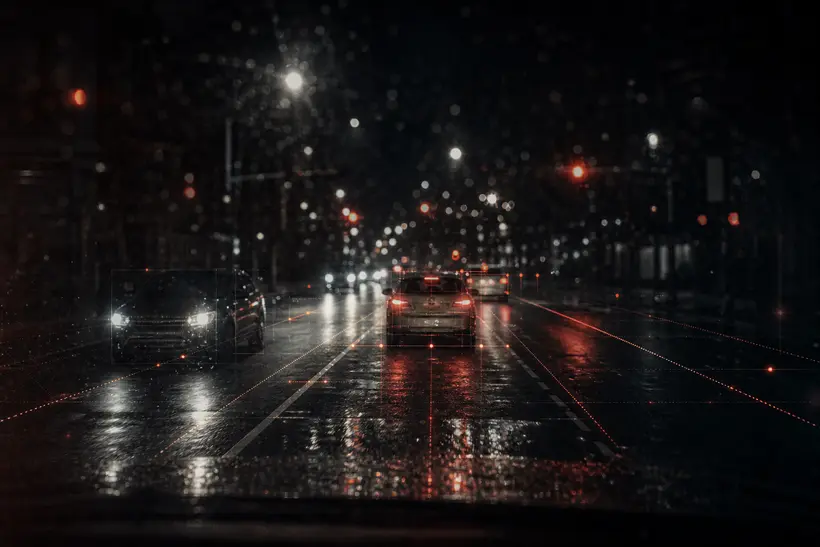
Autonomous vision
Vehicles trust camera feeds with no attestation.
It's time to prove what's real.
Not detect. Not guess. Not flag. Prove.
Provenance, built into the shutter.
Take a photo and it is signed at the shutter, then sealed into a tamper-evident Content Credential. No new workflow — the proof travels with the file.
- Signed in the iPhone's Secure Enclave
- Device-attested via Apple App Attest
- RFC 3161 trusted timestamp
- Written to the open C2PA standard
In early access via TestFlight.
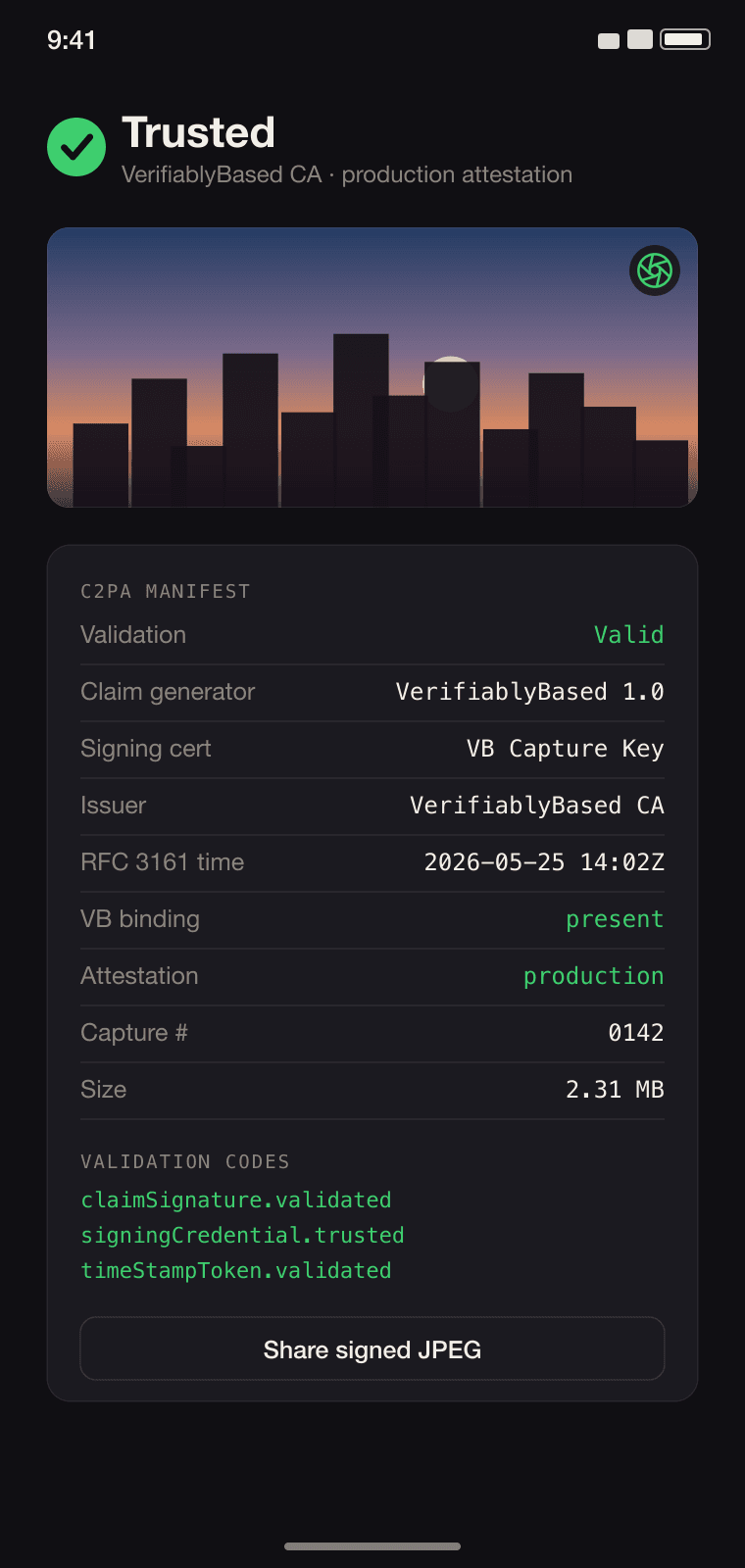
Anyone can check it.
Drop a photo into the browser verifier or call the SDK. It confirms the photo came from the VB app on an attested iPhone, unchanged since capture — chaining to the VB certificate authority, on track for the C2PA Trust List.
No account · no server · the check runs locally.
Every photo leaves your phone with a credential attached.
One photo, end to end.
No trust required.
Software proves origin. Hardware will prove the scene.
App provenance proves a photo came from our app on an attested iPhone, at a known time, unchanged since. What it can't prove is that the pixels began at a real sensor pointed at a real scene — show any phone camera a screen or an injected feed and the software faithfully signs it. That gap is why we're building hardware.
Provenance
Origin and integrity: every photo is C2PA-signed, device-attested, and timestamped — verifiable by anyone, no account or server. The trust layer for the phone you already carry.
iOS app · C2PAFortress
A MagSafe-attachable camera module that roots trust in physics — the unclonable electrical characteristics of the silicon sensor itself, which cannot be cloned, extracted, or simulated. It attests that a real sensor captured a real scene, closing the gap software can't. It clips to the phone you already carry.
MagSafe module · sensor PUFWe ship the software trust layer today and extend it to hardware-rooted sensor proof tomorrow — same open standard, same verifier, a deeper root of trust.
Attestation chain
- App Attestdevice
- Secure Enclavesigns
- C2PA Manifestclaim
- RFC 3161 Timestampwhen
- VB Trust CAchains
- Verifiable PhotoC2PA
// verify a photo anywhere — open C2PA standard, no account
import { verify } from "@verifiablybased/sdk";

const { ok, app, device, signedAt } = await verify(imageBytes);

if (ok) {
  console.log("captured in app", app.name);    // VerifiablyBased
  console.log("attested device", device.model);
  console.log("signed at", signedAt); // RFC 3161 timestamp
}
Provenance to an open standard.
Every photo carries a C2PA manifest — a Content Credential recording who captured it and that it's unaltered. It's the cross-industry standard (Adobe, Microsoft, the BBC), so any compliant tool can read it — the proof isn't ours to gatekeep.
Signed by the device, attested as genuine.
The signing key lives in the iPhone's Secure Enclave and never leaves it. Apple's App Attest vouches that the signature came from the real VB app on a genuine device — not a script, emulator, or tampered build.
Independent proof of when.
Each manifest carries an RFC 3161 timestamp from an independent authority — the capture time is asserted by a third party, not merely claimed by the phone.
Open verification, everywhere.
Credentials chain to the VB certificate authority, on track for the C2PA Trust List. Any app can verify a photo in one client-side call. The verifier is free — trust as infrastructure, not a subscription.
Rooting trust in the sensor.
Software proves a photo's origin and integrity, but not that a real sensor saw a real scene. Our hardware roadmap closes that gap: a MagSafe camera module whose silicon Physical Unclonable Function (PUF) binds each capture to one physical sensor — unclonable, unextractable — with zero-knowledge proofs that attest authenticity without exposing device identity. In development.
The era of provable images starts here.
The iOS app is in early access — request a TestFlight invite and SDK access. The same list follows the MagSafe hardware module as it comes together.